
News & Events

Misophonia Research Fund announces the second awardees for their Data Discovery seed grant
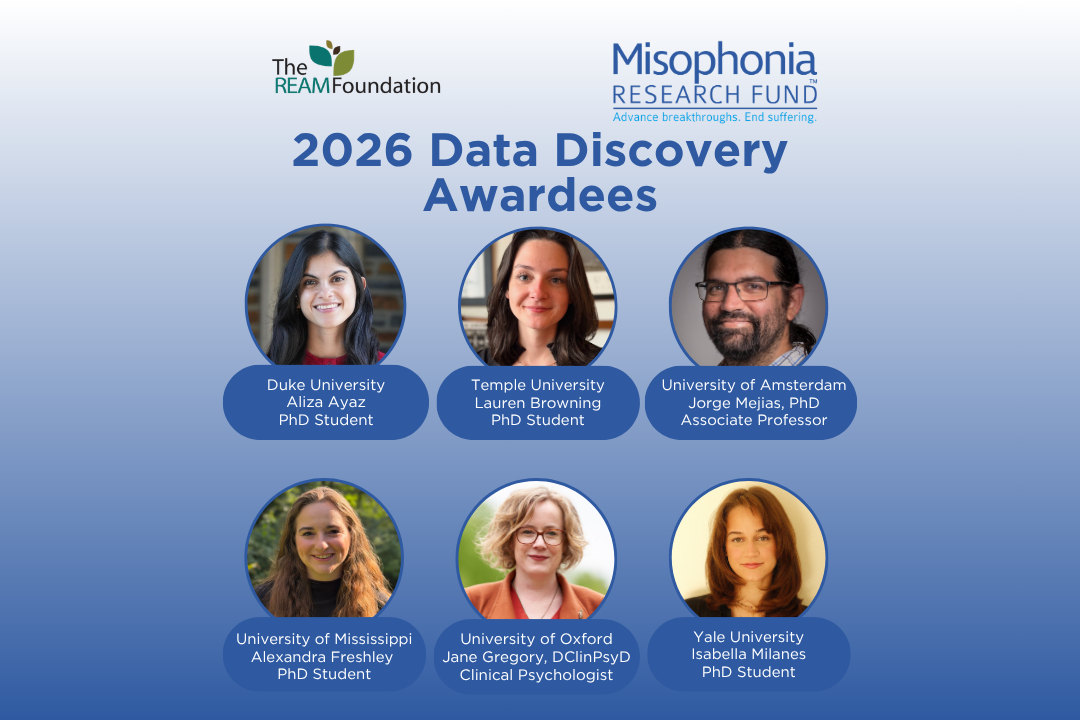
Today, the Misophonia Research Fund (MRF), an initiative of the REAM Foundation, proudly announces the second cohort of the Misophonia Grant Mechanism, building upon the momentum of accelerating research into this underrecognized disorder. These newly funded projects join 53 groundbreaking initiatives already supported by the MRF, with $17 million+ in total research investment thus far. These projects are all united in the mission to build a fundamental understanding of misophonia and advance the development of effective diagnostics and treatments. By providing critical seed funding at this early stage, we aim to catalyze innovation, attract new talent to the field and lay the scientific groundwork needed to transform care for those living with misophonia. This next cohort will explore diverse and high-impact areas—from developmental studies to the testing of novel therapeutic approaches.
2026 Data Discovery grant recipients:
- Duke University, where Ph.D. student Aliza Ayaz will examine and compare white matter pathways in misophonia with both clinical and healthy control groups.
- Temple University, where Ph.D. student Lauren Browning will observe children with and without misophonia, and their parents, to identify the relevant parent-child situations that can serve as potential intervention targets.
- University of Amsterdam, where Associate Professor Jorge Mejias, Ph.D. will utilize existing fMRI data to better understand whether hearing, emotion, and attention systems are involved in misophonia.
- University of Mississippi, where Ph.D. student Alexandra Freshley will develop a specialized single-session interventions for misophonia and evaluate its acceptability and feasibility as a potential intervention.
- University of Oxford, where Jane Gregory, DClinPsy will work with individuals with misophonia to create digital, self-help content based on cognitive-behavioral therapy.
- Yale University, where Ph.D. student Isabella Milanes will examine the role of genetic risk scores for commonly co-occurring psychiatric and auditory conditions in misophonia.
These grantees will receive a combined total of greater than $350,000 in funding, with projects expected to span 1-2 years. Through their work, the MRF hopes to accelerate the path to effective treatments and improve the quality of life for those living with misophonia.
Visit the MRF website for more information about MRF-funded research.
Types of Funding Mechanisms with the Misophonia Research Fund
Calls for the 2027 MRF funding cycle will open in the fall of 2026. In addition to its $200,000-$500,000 Misophonia Research Grant mechanism, the MRF will continue its $75,000 Misophonia Data Discovery Grant mechanism to support the acquisition of datasets to seed larger projects. Established investigators, postdoctoral researchers, and graduate students dedicated to advancing a world where misophonia is scientifically understood and effectively treatable are encouraged to apply.
About the Misophonia Research Fund
The Misophonia Research Fund (MRF) is focused on advancing scientific breakthroughs and ending suffering from misophonia. MRF was launched in 2019 with an inaugural round of funding for medical research grants that seek to better understand misophonia, diagnose people who have the condition, and assess treatment strategies. MRF is an initiative of The REAM Foundation, a private family foundation. Through a competitive grants program, MRF seeks to foster innovative science and new treatments for misophonia. For more information, visit MisophoniaResearchFund.org.
Subscribe to the MRF Mailing List
Funding Opportunities
Explore a variety of resources and impactful organizations for those seeking support for misophonia or looking to get involved.
Have Questions?
Interested in learning more about misophonia, our currently-funded research, available funding, or more?