
News & Events

Understanding Misophonia: Interview with Dr. Joel Berger
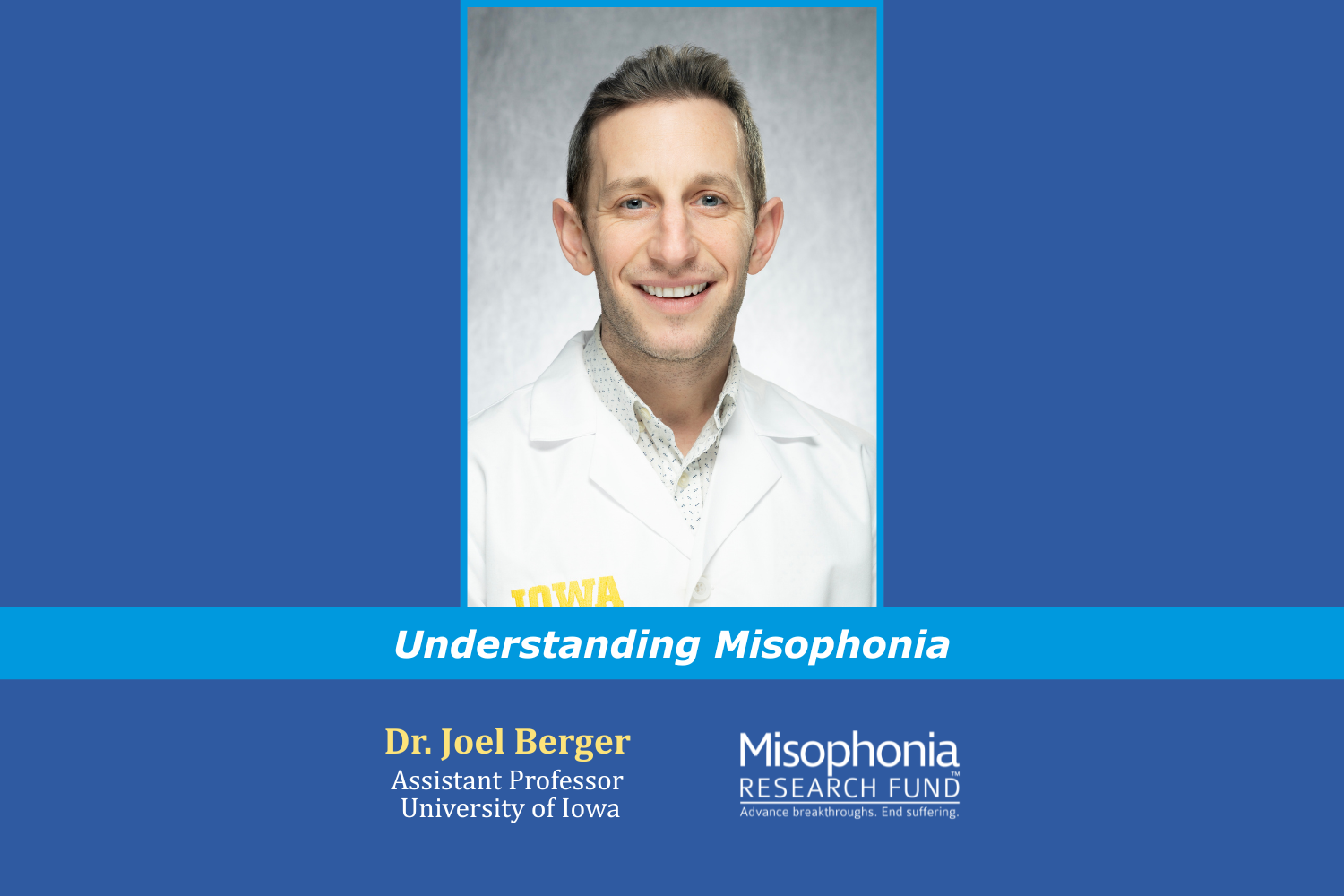
Understanding misophonia is a goal that researchers, clinicians, and the community all collectively share. Having more awareness of the disorder can help teachers support students, families reduce tension at home, and friends and partners avoid misunderstandings.
This campaign about Understanding Misophonia is intended to share the research from scientists and clinicians that provides evidence that misophonia is real and rooted in the brain.
Dr. Joel Berger, Assistant Professor at the University of Iowa, shares about his research below.
1. When you think about misophonia at the brain level, what areas of the brain seem to be most important, and why?
Consistently across studies, we see motor cortex (which controls movement) and insula cortex (a complex area involved in linking senses to emotions) as regions involved in misophonia. This highlights that we need to think of misophonia beyond just the sounds themselves and instead consider that it involves higher-level aspects of trigger sounds, such as the context in which they are perceived or the perception of the source that generates that sound. With what we understand currently and the data that are emerging, the insula in particular is a very interesting brain region to focus on, understanding exactly why it is so consistently activated in misophonia, what the meaning of this actually is and whether we can focus stimulation strategies to reduce its hyperactivity.
2. What do we currently understand about how the brain processes trigger sounds differently in misophonia?
In those with misophonia, brain regions involved largely in processing the basic acoustic properties of sounds, such as the primary auditory cortex, do not seem to show very different activity between those with misophonia and those without. Once you start to move up what we would call the “processing hierarchy” then you see differences in brain activity. Therefore, regions involved in processing social context and motor empathy (the perception of others' motor movements) seem to matter most for differentiating whether someone has misophonia to trigger sounds or not.
3. Can context come into play to affect people’s misophonic reactions?
Absolutely, context is a key factor in how someone responds to a particular sound. Anecdotally, people often report the strongest reactions to those closest to them, which further supports the idea of context being crucial. In fact, I think that context is something we can use to develop effective treatment strategies. This is one way in which cognitive behavioral therapy can be helpful, in that it reframes the context in which sounds are perceived and therefore can reduce the subsequent response. I believe that therapies that include an attempt to modulate the contextual representations of these sounds may prove to be the most effective in the future.
4. Tell us about your research and social cognition model for misophonia.
Our research currently focuses on determining whether the brain regions involved in misophonia are specific to the types of triggers that bother someone. We know that many people are bothered by mouth sounds, while some are bothered by hand sounds and some are not. We have also known for a very long time that the motor cortex is separated into distinct regions that represent different parts of our body (known by some as the “motor homunculus”). Therefore, if you have someone who is bothered by hand sounds, does their hand motor cortex activate more when listening to hand sounds, compared to someone who is only bothered by mouth sounds? We are currently in the process of finalizing analyses of a large dataset we have collected and understanding the nature of this specificity will be crucial for developing individualized, targeted treatments in the future. Interestingly, for this study, it was very difficult to recruit people who were bothered by hand sounds but not by mouth sounds, which was our original aim, so we had to adjust the study accordingly. That isn’t to say this phenomenon doesn’t exist, but the high prevalence of mouth sounds being a trigger I think tells us something about the nature of misophonia in a large proportion of people (as a sidenote, much like with tinnitus, we likely need to also consider the heterogeneity and individualized aspects of the condition).
Sukhbinder Kumar and I developed our social cognition model based on observations he had made from his own imaging studies, in particular his 2021 paper. This model really brings together some of the points I have mentioned above that are central to misophonia – that social context is crucial, the brain regions most involved in misophonia are those involved in social cognition and that the acoustic properties of the sounds themselves are not necessarily the vital factor in something being a trigger sound.
5. What is one finding from your research that helps shed light on possible mechanisms for misophonia?
First, we are yet again consistently finding the insula cortex coming out as being hyperactivated in misophonia with our current study. The final analyses comparing groups are ongoing. Additionally, we recently performed a large-scale online study, the results of which are in preparation for a manuscript. We hypothesized that misophonia would be linked to a heightened degree of empathy, in particular somatic empathy, which is an understanding of someone else’s feelings that relate to their own physical discomfort. This hypothesis was based on the finding of the insula cortex being activated consistently, which is well known to be involved in empathy, as well as our previous finding that the incidence of mimicry (i.e. creating the same actions that others are making) is very high in misophonia, often as a coping strategy. From this latest dataset we are finding that somatic empathy does indeed appear to be higher in those with misophonia, and yet again finding a comparable incidence of mimicry.
6. How has input from people with lived experience shaped your understanding of misophonia?
I have family members that experience misophonia. Growing up in the nineties before the condition was termed, there was a general lack of understanding of what they were actually going through and therefore an underappreciation of just how difficult this can be as an experience. I am now particularly aware of the automatic nature of their experience – that is, it isn’t a reaction they can easily help – and therefore highly motivated to discover the mechanisms related to this condition and ultimately provide them and others with effective treatment strategies.
We thank Dr. Berger and his team for their dedication to misophonia research and advocacy. To learn more about Dr. Berger’s misophonia research and participate, please visit his lab’s website here.
Subscribe to the MRF Mailing List
Funding Opportunities
Explore a variety of resources and impactful organizations for those seeking support for misophonia or looking to get involved.
Have Questions?
Interested in learning more about misophonia, our currently-funded research, available funding, or more?