
News & Events

Understanding Misophonia: Interview with Dr. Thomas Fernandez
Understanding misophonia is a goal that researchers, clinicians, and the community all collectively share. Having more awareness of the disorder can help teachers support students, families reduce tension at home, and friends and partners avoid misunderstandings.
This campaign about Understanding Misophonia is intended to share the research from scientists and clinicians that provides evidence that misophonia is real and rooted in the brain.
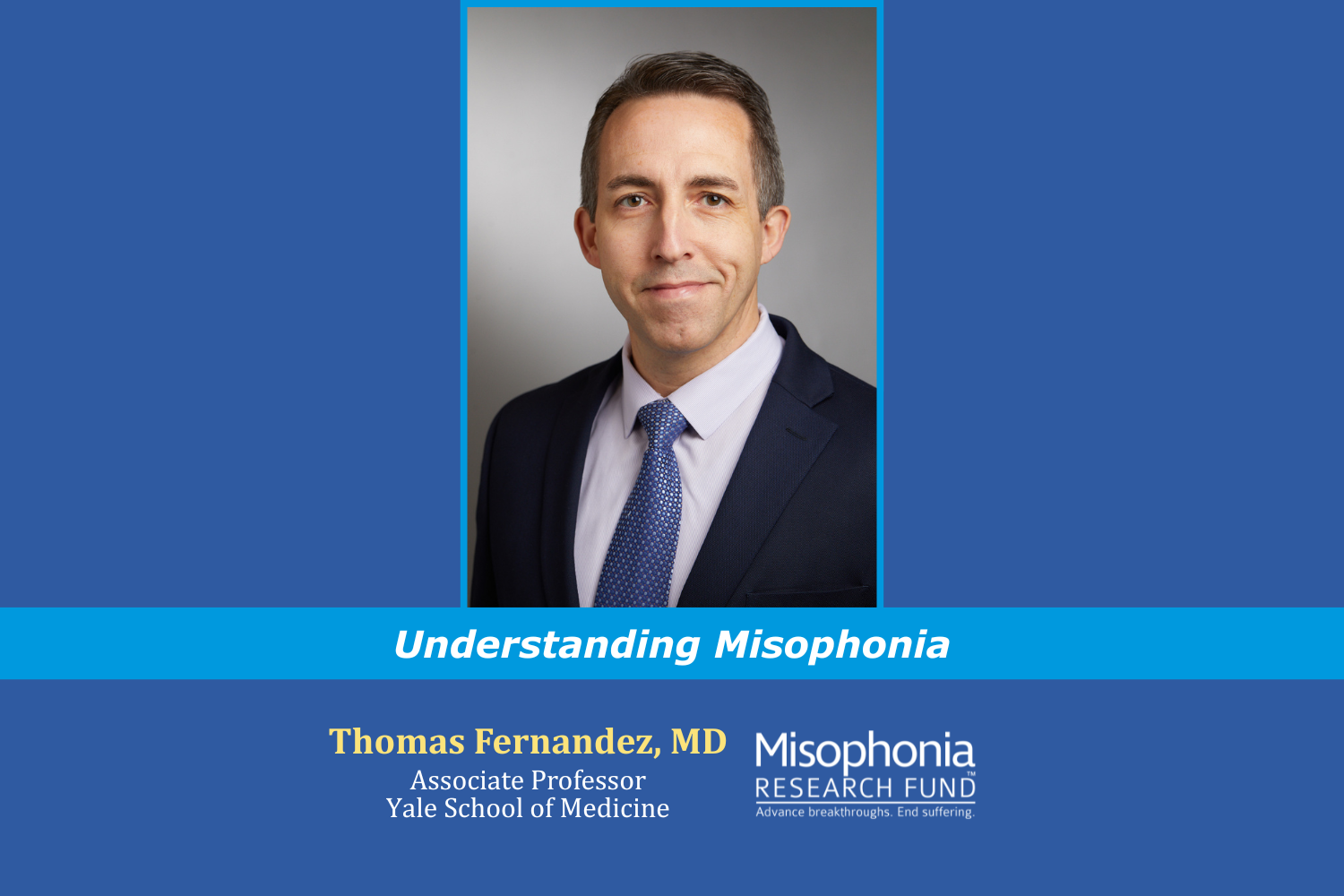
Dr. Thomas Fernandez, Associate Professor at the Yale School of Medicine, shares about his research below.
1. Are there any genes or genetic factors associated with misophonia?
We’re at the very beginning of answering this, and I want to be honest about that. There is no single “misophonia gene” that anyone has identified, and I’d be skeptical of anyone who claimed otherwise. That said, the clues pointing to genetics are real. A large study back in 2015, using data from roughly 17,000 people, found a genetic signal near a gene called TENM2 that is involved in how the brain wires itself during development. That was the first hint that common genetic differences play some role. We also know misophonia tends to run in families, which is one of the strongest signs that genes are part of the story. What our field expects, based on closely related conditions, is that misophonia won’t trace back to one gene but to many genetic factors, each contributing a small piece. Our project is one of the first efforts to start building that map systematically.
2. Can family history play a role in whether someone develops misophonia?
Yes, and this is one of the clearest signals we see. Misophonia often runs in families. In a study we recently posted from this project, about 40% of people with misophonia had a close relative, a parent or sibling, who also had it, and nearly half had an affected relative somewhere in the extended family. We also found that affected individuals were more likely to have an affected mother than an affected father, and that their relatives had high rates of related conditions like anxiety and depression. So it isn’t only misophonia that seems to travel through these families, but a broader predisposition. I do want to add an important caveat. Family history is not destiny. Having a relative with misophonia doesn’t mean someone will definitely develop it, and someone with no family history can still have it. But the pattern is a strong clue that inherited biology is involved, and it’s a big part of why we designed this study around families.
3. Tell us about your research on misophonia and genetics.
Our project is, to our knowledge, the first to use whole-genome DNA sequencing in families affected by misophonia. We focus on what we call “trios,” meaning a person with misophonia together with both of their biological parents. Studying all three at once is powerful because it lets us tell which genetic variants a person inherited from a parent and which arose brand new in them (what geneticists call “de novo,” or spontaneous, variants). Families generously take part from home, completing questionnaires online and mailing us a saliva sample, from which we extract DNA. We then read both the protein-coding part of the genome in depth and the rest of the genome more broadly, and we compare what we find against thousands of families without misophonia. Our goal is to identify the genes, biological pathways, and developmental windows involved in misophonia and to create a shared, lasting resource that other scientists can build on. We’ve now enrolled over a hundred families and are deep into the sequencing and analysis phase.
4. What is one finding from your research that helps shed light on possible mechanisms for misophonia?
The early finding I find most intriguing is that, in our pilot data, people with misophonia appear to carry more rare, likely-damaging spontaneous genetic changes than we’d expect by chance, a pattern very similar to what’s been seen in other neurodevelopmental conditions where this approach has successfully pointed to specific genes and biology. I want to stress that this is preliminary and from a small initial sample, and we’re now testing it in our full cohort. Alongside the genetics, our clinical data tell a consistent story. Misophonia tends to begin in childhood, often around age 10, and frequently appears together with anxiety, and in our recent family history study, relatives of people with misophonia also had elevated rates of anxiety and depression. To me, those threads, a possible genetic signal, and misophonia clustering in families alongside related conditions early in life, point to misophonia having real, identifiable roots in how the brain develops and processes certain signals, very likely sharing some biology with the way the brain handles emotion and salience. It is not a matter of willpower or being “too sensitive,” and I think that reframing matters.
5. What could a “next-generation” treatment for misophonia look like if it were informed by genetics?
Right now, the tools we have are coping and behavioral strategies, which help many people but don’t target the underlying biology, partly because we don’t yet know what that biology is. That’s exactly the gap genetics could close. If we can identify the genes and biological pathways involved, several doors open. We could look for medications, including drugs already used for other conditions, that act on the same pathways. We could grow simplified models of brain tissue in the lab (“organoids”) to test which compounds actually change the relevant biology before anything reaches a person. Genetics might also reveal that misophonia comes in distinct subtypes, which would let us match each person to the treatment most likely to help them, rather than a one-size-fits-all approach. Further down the road, the same biology could point to earlier and more objective ways to recognize misophonia. None of this is around the corner, and it’s foundational work, but it is the path from managing symptoms toward treating causes.
6. How has input from people with lived experience shaped your understanding of misophonia?
Profoundly, because this research wouldn’t exist without the misophonia community. The advocacy organizations and the families themselves have been our partners from the start, not just our participants. I want to specifically credit SoQuiet and its Lived Experience Action Panel (LEAP), which has been incredibly helpful in shaping how we communicate our work. As one concrete example, the LEAP reviewed our recent family-history preprint to ensure it accurately and earnestly represented people who personally experience misophonia. This is the kind of input that changes how we word and frame what we report, not just what we study. Listening to people who live with misophonia has shaped what we measure and how we interpret it, including the reality that it usually starts in childhood, the weight of co-occurring struggles like anxiety, and how much it affects daily life and relationships. Genetics is the engine of this project, but the lived-experience community keeps us pointed toward what actually matters to the people we’re trying to help.
We thank Dr. Fernandez and his team for their dedication to misophonia research and advocacy. To learn more about Dr. Fernandez’s misophonia research and participate, please visit his lab’s website here.
Subscribe to the MRF Mailing List
Funding Opportunities
Explore a variety of resources and impactful organizations for those seeking support for misophonia or looking to get involved.
Have Questions?
Interested in learning more about misophonia, our currently-funded research, available funding, or more?